
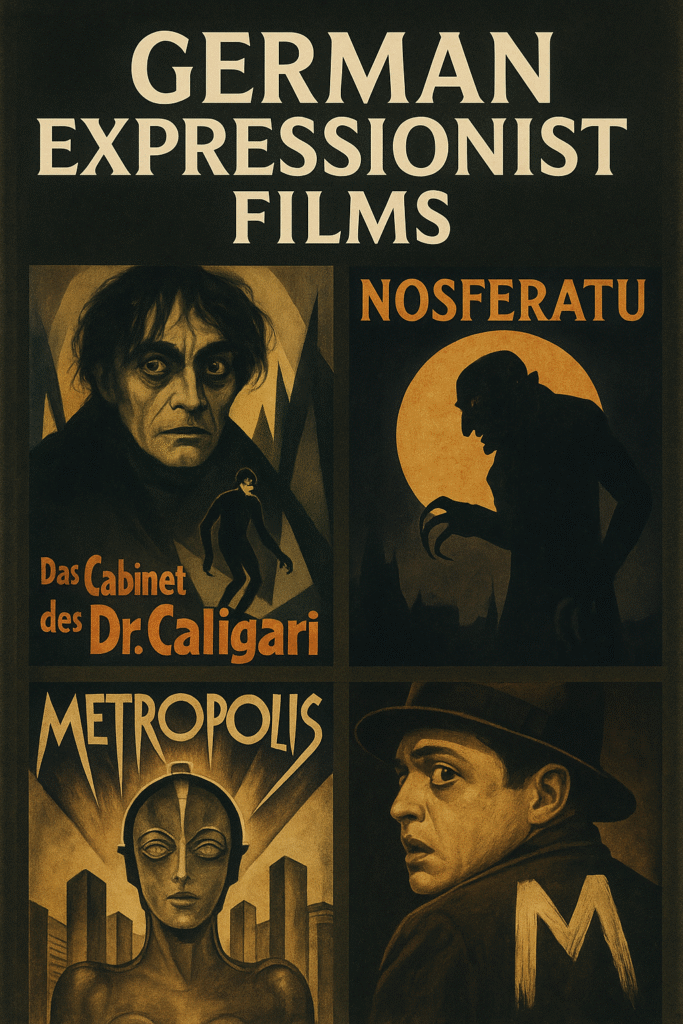
German Expressionist film emerged when Germany was still struggling with the chaos of World War I. Everything and everyone in the country was grappling with the horrific trauma of the war, soaring prices, unemployment, and existential dread.
People sought refuge in artistic expressions of their distorted, dismembered inner mind. It was the time while the world of expressionist cinema was beginning to take its shape following the widespread popularity of the expressionist art movement in Europe. These expressionist films weren’t just made for visual aesthetics; they were made for the free expression of the inner conflict of the human psyche of the time, making them the most magical dreamscapes of the common people.
Expressionism: A Path-breaking Style in Silent Cinema
German expressionist cinema (Deutsches expressionistisches Kino in German) was one of the most popular styles of the silent cinema.
Expressionism was an artistic movement that started in Europe in the early 20th century. This movement focused on the inner conflicts and emotions of the artist rather than a realistic portrayal of the outer reality.
Unlike realism, expressionists preferred to emphasize the inner turmoil of grief, fear, paranoia, and alienation. The sets of the films were designed in twisted, surreal ways, frames filled with warped lines and unsettling architecture. Lighting was used to create deep shadows and sharp contrasts, filling every frame with unease. Characters appeared ghost-like, as if they were trapped in a world where reality itself has fractured. It was a visual scream. A terrific beauty is found in the broken and the grotesque.
German film critic Lotte Eisner used a German term, Helldunkel, to define this style of cinema. Helldunkel means “a sort of twilight of the German soul, expressing itself in shadowy, enigmatic interiors, or in misty, insubstantial landscapes.”
The Classics of Expressionist Cinema
If you want to feel the macabre breadth of German expressionist films, here’s a list of some of the classics that defined the movement:
1. The Cabinet of Dr. Caligari (1920) by Robert Wiene
The Cabinet of Dr. Caligari depicts the horror and trauma of World War I as experienced by the two writers of the film, Hans Janowitz and Carl Mayer. Robert Wiene used the aesthetics of expressionism to portray the broken, disfigured reality as it is, making it a cinematic masterpiece.
2. Nosferatu (1922) by F. W. Murnau
Nosferatu is referred to as the first of all vampire movies. An adaptation of Bram Stoker’s “Dracula,” this movie can be listed as one of the most visually effective horror films to date.
The movie is a shadowy silhouette on the stairs, arms stretched like death’s wings. Horror born not from gore, but from atmosphere. It crawls into your dreams.
3. Metropolis (1927) by Fritz Lang
Metropolis creates a futuristic city full of skyscrapers, machines, and robots. It’s a hope flickering amid the clash between machine and human. This film is a marvelous cinematic meditation on a future that feels too familiar and too near.
The Features of Expressionist Cinema
Set Design: Lurking shadowy figures, misshapen windows, and abstract perspectives, like a nightmare carved from cardboard, filled the set of these movies.
Lighting: German Expressionist films are known for their use of the chiaroscuro lighting technique. It’s a technique where high contrasts of darks and lights are blended together to build nightmarish sets.
Themes: Madness, duality, fate, fear, and societal alienation are some of the recurring themes of expressionist cinema.
Acting Style: Highly theatrical, exaggerated, stylized, and almost balletic methods of acting were another feature of these films that made them stand apart.
The Legacy of Expressionist Film
Expressionism left a long-lasting impact on cinema history. From Hollywood’s film noir and horror to futuristic sci-fi movies, German Expressionism influenced it all. Many Hollywood directors were inspired by the stylistics of this movement.
Alfred Hitchcock, the iconic filmmaker, was impressed by the psychological tension of Expressionism. He wove the unsettling moods and the shadowy terrors into his thrillers with precision and restraint. Tim Burton, another modern-age expressionist, borrowed that same visual style and turned it into a gothic celebration of exaggerated forms and eerie whimsy.
Parting Words
German Expressionist cinema tells us about the importance of distorting the reality, darkening the screen with our own inner turmoil to make the art of cinema feel truthful.
As Bertolt Brecht once observed, “Art is not a mirror held up to reality, but a hammer with which to shape it.” If this post sparked something in your cinematic soul, stay tuned.